How IBM’s Watson Could Impact Medicine

I was asked to write an op-ed for the Washington Post on how Watson (the computer that won on Jeopardy!) could impact medicine. I think it could eventually be quite transformative.

You can read it here

Update

Mark Lewis, a computer science professor at Trinity University, thinks I might be too conservative in my projections for Watson’s future impact on medicine.

My feeling has been that in areas like medicine and self-driving cars/trucks the technology may run ahead of social acceptance. Also there are some powerful groups that might lobby hard to slow progress (AMA, Teamsters, etc.).

How long will it be, for example, before society would trust a machine to independently prescribe drugs? (Possible future Kindle bestseller: How to Get Watson to Give You Vicoden: The Insider’s Guide). But, then again, which would be harder: gaming a smart computer to get a prescription, or just finding a doctor that will prescribe on demand?

I’ve heard from a number of people who, like Mark, think things are likely to progress faster than we might expect in these areas. Let us know what you think in comments.

Could Income Inequality Lead To Civil Unrest in the United States?

Washington’s blog has a post on the possibility that: Raging Inequality May Cause Unrest and Violence In America and the Rest of Western World.

This is something that I’ve been wondering about for quite a while. I’ve been writing here primarily about the impact of technology on the job market, and I think it is clearly one of the primary reasons for the ever-increasing inequality we’ve seen over the past few decades.  Although there are certainly other important factors, including the demise of private sector unions, globalization and perhaps the entry of millions of women into the workforce. 

There is also, of course, a positive feedback loop between the concentration of income and wealth, and the concentration of political influence.  Extreme income inequality allows a few wealthy members of society to effectively capture the political process and push through an agenda that is in their favor. In the U.S. this has resulted in dramatically lower marginal tax rates on the wealthy, and also an unsustainably low rate of overall taxation: The U.S. currently collects about 14% of GDP in federal taxes, as compared with a historical average of 18%.

The problem I see going forward is that there is really nothing whatsoever on the horizon to counteract the trend toward increasing inequality. The trend was reversed in the 1930s by direct government intervention.  The time when policies of that type might have been implemented seems to be past — we are now moving aggressively in the opposite direction, and austerity measures seem likely to accelerate the drive toward even more inequality.

While we can have a reasonable debate  about which forces have led to the concentration of income we now face, I would argue strongly that technology will be the primary factor going forward. I believe this because of the exponential progress of information technology.

If you get in your car and gradually double your speed, so you are travelling at 5, 10, 20, 40 and finally 80 miles per hour, that would be similar to the way computing power continues to advance. And the point is that when you are going 80 miles an hour you cover far more ground that when you were just starting out.

That’s where we find ourselves today: information technology has beeen progressing for decades and is now reaching the level where advances in areas like artificial intelligence and robotics are likely to unfold far more rapidly than most people expect. This could impact jobs at virtually all levels:  from fast food workers to professionals with college degrees. 

Corporate managers won’t hesitate to deploy these technologies throughout their organizations, and they’ll collect huge bonuses as a reward for doing so. The result may well be even more dramatic concentration of income as those who own or control large amounts of capital (CEOs, Wall Street) win big and the vast majority of people who rely on wages or salaries continue to lose out as they face higher unemployment and stagnant wages — perhaps in the face of significant food and energy inflation.

If inequality continues to increase relentlessly, it seems likely that major social disruptions are inevitable. We see this in Europe and the Middle East already. What people should keep in mind is that — despite conservative rhetoric about the welfare state — the U.S. has the weakest social safety net of any advanced country. Once you exhaust your unemployment benefits and your savings, you are in serious trouble if you can’t either find a job or get someone to take you in.  

The current recession has now been going on for so long that one has to begin to wonder how many families out there are getting close to the brink. At the same time, huge numbers of young people are unemployed and probably see little prospect of that changing anytime soon. That has been one of the primary drivers of unrest in the Middle East.

One argument against the possibility of unrest in the U.S. is that there seems to be no clear organizing mechanism. In the past, private sector unions were heavily involved in organizing people, but their influence is now greatly diminished. In the Middle East, social media has played a key role.

Another issue is that many people seem to be confused or uninformed about what policies are in their own self-interest. A large percentage of the population does not realize (or acknowledge) that it receives substantial benefits from the government. We see Tea Party supporters — many relying on Social Security and Medicare — who seem to truly believe that it would be better if the debt ceiling is not raised.

Is it possible or likely that we’ll have social unrest in the U.S?  Please leave a comment and let us know what you think.

Updates

This is also running over at Huffingtonpost, where it has over 1000 comments so far…

Maybe I should have said “United Kingdom” rather than “United States.”  But stay tuned, U.S. austerity measures have not been fully implemented yet…

Google+ … and Social Networking

I’m making my first (believe it or not) attempt at social networking with the new Google+. The service has been getting a lot of buzz; according to the San Jose Mercury News, it’s being used by a lot of  “Silicon Valley insiders.”

I’ve set up a profile and started a discussion about the impact of technology (especially automation/robotics/AI) on the job market and economy.

You can view it here

Right now, Google+ is in test mode, so if you don’t have access and would like to participate in the discussion, click here to get an invitation to join Google+ . Once you have an account, you can invite others.

I don’t use Facebook, but one of my readers was kind enough to set up a page for my book, The Lights in the Tunnel:

http://www.facebook.com/pages/Lights-in-the-Tunnel/145229482171278

Social media has been ablaze because Netflix just raised its prices.  I do think that the issues discussed on this blog are going to be (or already are) a much bigger deal than the extra six dollars a month that Netflix is charging…

If any of my readers are active Facebook/Twitter users, I’d certainly appreciate it if you’d try to bring more attention to these issues.

Productivity and Employment — A Structural Change?

Jared Bernstein has a post on long-term job growth with a graph showing the historical relationship between productivity and employment:

People sometimes worry that we’re getting too productive, able to satisfy the demands of our economy with “too few” workers.  That’s an age-old worry, and those who want to downplay it cite the fact that, as the graph shows, there is a positive, not a negative, correlation between productivity and job growth overtime.

But look at the end of the graph.  Productivity accelerates while employment growth decelerates.  And that ain’t no blip either…it suggests the possibility of a structural change in this relationship.


Now here is the section on the relationship between workers and machines from my book The Lights in the Tunnel. Compare the graph above to the one from my book below and notice that they both have diverging lines that seem to be saying something similar:

_____________

The Average Worker and the Average Machine

Think of an average worker using an average machine somewhere in the economy. Obviously, in the real world there are millions of workers using millions of different machines. Over time, of course, those machines have gotten far more sophisticated. Imagine a typical machine that is generally representative of all machines in the economy. At one time, that machine might have been a water wheel driving a mill. Then it became something driven by a steam engine. Later, an industrial machine powered by electricity. Today, the machine is probably controlled by a computer or by embedded microprocessors.

As the average machine has gotten more sophisticated, the wages of the worker operating that machine have increased.*  As I pointed out in the previous section, more sophisticated machines also make production more efficient and that results in lower prices and, therefore, more money left in consumers’ pockets. Consumers then go out and spend that extra money, and that creates jobs for more workers who are likewise operating machines that keep getting better.

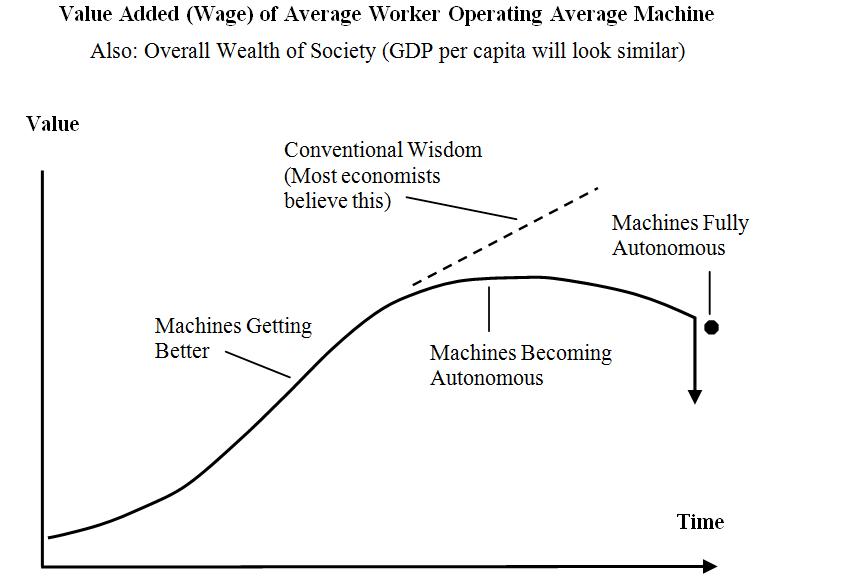
Again, the question we have to ask is: Can this process continue forever? I think the answer is no, and the very unpleasant graph below illustrates this.

Average Worker and Average Machine

The problem, of course, is that machines are going to get more autonomous. You can see this in the graph at the point where the dotted line (conventional wisdom) and the solid line diverge. As more machines begin to run themselves, the value that the average worker adds begins to decline. Remember that we are talking here about average workers. To get the graph above, you might take the distribution of incomes in the United States and then eliminate both the richest and the poorest people. Then graph the average income of the remaining “typical” people (the bulk of consumers) over time. If you were to instead graph Gross Domestic Product (GDP) per capita, you would end up with a similar graph, but the divergence between the dotted and the solid lines would occur somewhat later. This is because the wealthiest people (who own the machines or have high skill levels) would initially benefit from automation and would drag up the average. Recall that we saw this in our tunnel simulation in Chapter 1.

Once the lines diverge, things get very ugly. This is because the basic mechanism that gets purchasing power into the hands of consumers is breaking down. Eventually, unemployment, low wages—and perhaps most importantly—consumer psychology will cause a very severe downturn. As the graph shows, within the context of our current economic rules, the idea of machines being “fully autonomous” is just a theoretical point that could never actually be reached.

Some people might feel that I am being overly simplistic in equating “technological progress” with “machines getting better.” After all, technology is not just physical machines; it is also techniques, processes and distributed knowledge. The reality, however, is that the historical distinction between machines and intellectual capital is blurring. It is now very difficult to separate innovative processes from the advancing information technology that nearly always enables and underlies them. Improved inventory management systems and database marketing are examples of innovative techniques, but they rely heavily on computers. In fact, we can conceivably think of nearly any process or technique as “software”—and, therefore, part of a machine. 

If you still have trouble accepting this scenario, you might try asking yourself a couple of questions: (1) Is it possible for a machine to keep getting better forever without eventually becoming autonomous? (2) Even if it is possible, then wouldn’t the machine someday become so sophisticated that its operation would be beyond the ability of the vast majority of average people? And wouldn’t that lead right back to making the machine autonomous?

_______

* The idea that long-term economic growth is, to a large extent, the result of advancing technology was formalized by economist Robert Solow in 1956. Economists have lots of different theories about how long-term growth and prosperity come about, but nearly all of them agree that technological progress plays a significant role.

Could Fast Food Automation Replace Low Wage Workers?

Millions of people hold low-wage, often part-time jobs in the fast food industry. Historically, low wages, few benefits and a high turnover rate have helped to make fast food openings relatively abundant. These jobs, together with other low-skill positions in retail, provide a kind of safety net for workers with few other options.

In the current economic environment, these jobs are, of course, much harder to get. McDonald’s recent high-profile initiative to hire 50,000 new workers resulted in over a million applications—numbers that give McDonald’s a lower acceptance rate than Harvard.

What about the future? Most forecasts assume that the fast food industry will continue to be a significant job creator. The Bureau of Labor Statistics ranks food preparation as one of the top four fastest-growing occupations, and that trend is expected to continue at least through 2018.

Is it possible that these projections miss the impact of technology? Could these jobs begin to disappear? For some insight into what could potentially happen, consider this article from the New York Times about the Kura sushi chain in Japan:

Efficiency is paramount at Kura: absent are the traditional sushi chefs and their painstaking attention to detail. In their place are sushi-making robots and an emphasis on efficiency.

Absent, too, are flocks of waiters. They have been largely replaced by conveyors belts that carry sushi to diners and remote managers who monitor Kura’s 262 restaurants from three control centers across Japan. (“We see gaps of over a meter between your sushi plates — please fix,” a manager said recently by telephone to a Kura restaurant 10 miles away.)

Absent, too, are the exorbitant prices of conventional sushi restaurants. At a Kura, a sushi plate goes for 100 yen, or about $1.22.

Such measures are helping Kura stay afloat even though the country’s once-profligate diners have tightened their belts in response to two decades of little economic growth and stagnant wages.

McDonald’s has already announced plans to install touch-screen ordering systems in over 7000 European locations. To me, it is not difficult to imagine many of the ideas being utilized at Kura eventually being deployed throughout the fast food and beverage industries.  If automated preparation and off-site store management work for sushi, then why not for burgers or lattes?

One important thing to take away from the sushi story is the way in which a stagnant economy can be a driving force behind increased automation. Almost any type of restaurant food is a discretionary purchase: if the price is too high, people can and will refuse to buy.  That presents a real problem if—as is the case now—businesses are seeing significant increases in the price of the food commodities they must purchase.  For a business that is squeezed between rising input prices and tepid demand, investment in labor-saving technology can represent one of the few viable paths to continued profitability.

Increased automation in fast food and beverage providers is likely to someday offer increased convenience, speed, and ordering accuracy. Robotic food preparation could also be viewed as more hygienic as fewer workers come into contact with food. And of course, price will ultimately be the determining factor. As one Kura sushi customer quoted by The Times notes:  “It’s such a bargain at 100 yen,” … “A real sushi restaurant?” he said. “I hardly go anymore.”

If jobs in the fast food industry start to disappear, or even if the rate of job growth slows significantly, the implications for the workers that depend on these jobs of last resort will be dire. There may be few other alternatives for workers at that skill level, especially since other low-wage retail jobs may be similarly threatened.

See Also:

Krugman and DeLong on Automation

“The Economist” on Innovation and Jobs

“The Economist” on Innovation and Jobs

This week’s issue of The Economist has an article on innovation and job creation: “Still full of ideas, but not making jobs“.

Here’s a quote:

America’s ability to innovate and raise productivity remains reasonably healthy. The problem is that the benefits of that innovation and productivity have become so narrowly concentrated that workers’ median wages have stagnated.

The article seems to imply that this is a temporary problem, and that we just need the right kind of innovation — something that will “share the benefits of innovation more widely.” 

The article also echos the conventional wisdom on the need for more education, saying: “Americans once led the world in educational attainment, but this is now barely rising while other countries have caught up (see article). ” Yet, the evidence on the ground shows that college graduates (even those with degrees in technical fields) are seeing increasing unemployment and underemployment, even as student debt levels soar.

The article completely ignores the issues I’ve been writing about here:

  • Specialized software automation and artificial intelligence applications—and in particular machine learning technology—will increasingly threaten knowledge-based occupations. This may be especially true of entry-level positions typically taken by new college graduates.
  • Robots are going to get better and cheaper, and ultimately they will invade a great many lower-wage occupations in the service sector.  These low-wage jobs are responsible for the majority of new jobs now being created.
  • The migration of all types of information and entertainment to digital format will continue. We have already seen substantial disruptions of business models in traditional labor-intensive industries as a result of this (print media, movie rentals, physical book stores, etc.).  As information is increasingly hosted in the cloud and delivered electronically, there will be fewer jobs.

Is it likely that future innovation will create new industries that are labor-intensive enough to keep up with growth in the labor force (at least 1 million new workers per year in the US) and also absorb potentially millions of people displaced from more traditional industries? I doubt it.  All the evidence suggests that the industries of the future will be technology-intensive with fewer opportunities for workers—especially those without elite, technical skills.

One of the few exceptions may be “green” jobs associated with installing solar panels, etc. However, these are largely temporary infrastructure jobs rather than permanent, sustainable positions, and the numbers seem unlikely to be sufficient to counteract the broader trend toward fewer jobs in other industries.

Machine Learning: A job killer?

VentureBeat reports that Clover, a startup company in Mountain View, CA, has received $5.5 million of funding to focus on machine learning technology. Machine learning is still in its infancy, but it has the potential to be a disruptive technology as it progresses.

Machine learning is one of the primary technologies that powers IBM’s Watson computer. Watson was able to achieve championship-level proficiency at Jeopardy! by analyzing thousands of previous Jeopardy! questions. One of the things I’ve tried to point out here, and also in my book The Lights in the Tunnel, is that any jobs that are routine and repetitive in nature—regardless of the skill and education required to perform the job—are going to be increasingly susceptible to automation. Now, most people would probably not characterize playing Jeopardy! at a championship level as a “routine and repetitive” activity. Yet, a machine was able to prevail.

Machine learning essentially allows a computer to analyze past situations (together with outcomes) and develop optimal, statistical-based rules that can be applied in the future.  In other words, machine learning is basically a way to take a seemingly non-routine task or job and turn it into something that can be handled by a computer.

Here’s why that’s important: in today’s business world nearly everything gets recorded. This often shows up as a privacy issue: web surfers and shoppers are disturbed to learn that their activities and preferences are recorded and used for profit. What receives less attention is the fact that everything happening internal to organizations is also probably being recorded.

All transactions are, of course, recorded. Customer interactions (sales, support, service), together with their ultimate resolution are recorded. Emails get recorded. Many tasks and decisions, together with outcomes, made by knowledge workers are likely recorded.

I would argue that all that data is probably the equivalent of the sample Jeopardy! questions that Watson used to analyze and become proficient. In other words, in large organizations there is an enormous amount of data (activities coupled with outcomes) that is waiting for a machine learning algorithm to come along and churn though it.  That may ultimately result in software automation applications of unprecedented sophistication. Anyone who sits in a cubicle performing a knowledge-based job may have cause for concern.

Robots Stealing Jobs? – CNBC

I had a brief appearance on CNBC this morning to talk about robots and automation. This was my first TV appearance, so hope it’s not too bad… I can’t embed it here, but you can see it on the CNBC site.

Also, here are a couple of good of good automation videos from Singularity Hub.

The first one shows automation at a memory card manufacturer. Notice how the more labor-intensive activities are all offshored to Asia; the US-based portions seem to be almost entirely automated. Also notice how the walls and ceilings are used to move materials. The full article is here.

http://www.youtube.com/watch?v=kvf29R7nXlM

Here’s a second article and video that show systems focused on sorting, moving materials, palletizing and shipping.

Krugman and DeLong on Automation

Two notable economists have recently weighed in on the issue that I’ve been writing about extensively here: job automation and its impact on the future economy.

Paul Krugman links to a 1996 article in which he imagined a future where “information technology would end up reducing, not increasing, the demand for highly educated workers, because a lot of what highly educated workers do could actually be replaced by sophisticated information processing — indeed, replaced more easily than a lot of manual labor.”

That’s very much inline with what I think is likely to happen. In fact The Atlantic recently published an excerpt in which I talk about how a Radioligist’s job might be easier to automate than a housekeeper’s.

Brad DeLong seems less concerned:

I don’t see a problem with the number of jobs: I don’t see any reason that technological unemployment should be any more in our future than it has been in our past.

Really? Keep in mind that in the U.S. we need to create over a million jobs a year just to keep up with population growth. Within the next decade or so, I think it’s likely that millions of jobs in both low skill areas and high skill occupations are going to be increasingly susceptible to automation. If that happens, we’ll need to replace all those jobs while still keeping up with growth in the workforce. (And of course that’s on top of digging out of the massive unemployment hole we’re currently in).

As Krugman notes, one economist that has done extensive work in this area is David Autor of MIT. Autor co-authored a paper that looked at how computers have substituted for labor going all the way back to the 1960s and found that, as we might expect, routine and repetitive jobs are highly susceptible to automation. Autor has found that, as a result, the job market is currently polarized: A great many of the middle-skill jobs that used to support a solid middle class lifestyle have been automated—leaving us with high skill/high wage jobs that require lots of education and training and lots of low skill jobs with very low wages.

The problem I think we face in the future is that both the high-end jobs and the low-end jobs may erode quite rapidly as information technology advances. The key thing to understand here is that our definition of what constitutes a “routine and repetitive” job is changing over time. At one time a repetitive job may have implied standing on an assembly line. As specialized artificial intelligence applications (like IBM’s Watson for example) get better, “routine and repetitive” may come to mean essentially anything that can be broken down into either intellectual or manual tasks that tend to get repeated. Keep in mind that it’s not necessary to automate entire jobs: if 50% of a worker’s tasks can be automated, then employment in that area can fall by half. When you begin to think in these terms, it becomes fairly difficult to make a list of jobs that (1) employ large numbers of people and (2) are completely safe from automation.

If high skill jobs that require college degrees start getting substantially automated, that will threaten an important aspect of the social contract: if there’s anything left of the American Dream, it is  the idea that if you work hard to educate yourself, you’ll have a better shot at prosperity. If that promise comes up short, it may ultimately destroy the incentive for broad-based pursuit of education. There’s significant evidence that this may already be happening: one study recent study suggests that as many as half of college graduates are ending up underemployed.

So if the high skill jobs begin to evaporate, those people will have to turn to lower-skill or trade jobs. We may see people who might otherwise have pursed advanced education competing for jobs as plumbers or mechanics. Perhaps they’ll win that competition. But then what happens to the person who would have actually been a better fit for that job?

Since the middle-skill jobs are already gone, those who fail to find high skill positions will fall down the rungs and have to compete for lower skill positions. And yet a lot of these “jobs of last resort” in areas like fast food, retail and other service sectors are also going to be susceptible to automation (See this recent article in the LA Times: “Retail jobs are disappearing as shoppers adjust to self-service.”)

What happens to the workers who lose the low skill jobs? Well, they won’t have many options; by definition if they’ve been working jobs of this type for any length of time, they have no savings to fall back on. Safety nets for adults without young children are few. Many of these people will be headed for a tent city (video).

What about Consumption?

What neither Krugman nor DeLong seems to have thought much about is the impact that all this has on consumption. Rising unemployment and declining wages has to impact consumer spending and confidence—perhaps dramatically. As I’ve pointed out previously, falling wages will put a deflationary squeeze on households. This is because major fixed costs such as housing (mortgage or rent), health insurance, food and energy will not fall even as income does fall. This will leave average households with less and less to spend on discretionary items—and that likely means weak demand for any business producing a non-essential product or service. And, hey, that’s most of the economy. Those businesses, in turn will see increasing pressure to lay off workers or further automate.

Every product and service produced by the economy ultimately gets purchased (consumed) by someone. In economic terms, “demand” means a desire or need for something—backed by the ability and willingness to pay for it. There are only two entities that create final demand for products and services: individual people and governments. (And we know that government can’t be the demand solution in the long run). It all comes down to individual people buying stuff.

Of course, businesses also purchase things, but that is NOT final demand. Businesses buy inputs that are used to produce something else. If there is no demand for what the business is producing it will shut down and stop buying inputs. A business may sell to another business, but somewhere down the line, that chain has to end at a person (or a government) buying something just because they want it or need it.

This point here is that a worker is also a consumer (and may support other consumers). These people drive final demand. When a worker is replaced by a machine, that machine does not go out and consume. The machine may use resources and spare parts, but again, those are business inputs—not final demand. If there is no one to buy what the machine is producing it will get shut down. So if we automate all the jobs, or most of the jobs, or if we drive wages so low that very few people have any discretionary income, then it is difficult to see how a modern mass-market economy can survive that.  (This is the primary focus of my book, The Lights in the Tunnel).

Some people (like CEOs of global corporations, for example) might argue that it is somehow ok to undermine broad-based consumption in the United States, because the rising consumer class in China and other emerging economies will pick up the slack. Aside from the fact that, as an American, I don’t find that very appealing, I’m very doubtful of that argument for a few reasons: (1) Chinese manufacturing will automate and may do so much more rapidly than was the case in the US because they simply have to import the technology, not invent it.  That will make it hard for China to create enough new jobs as millions of workers continue to migrate from the countryside to cities. (2) China is still highly dependent on exports and the US is a vital market. A major decline in consumption here will cause unemployment in China, and that will make it very difficult for the Chinese to rebalance their economy toward more domestic consumption. This is something they have been talking about for years but can never seem to pull off . If the average Chinese sees increasing unemployment and an uncertain future, it’s just not going to happen, and the Chinese economy will remain dependent on exports and infrastructure investment.

In general, I think this is a problem that a great many people should be giving serious consideration. Information technology continues to accelerate:  the impact will be here long before we are ready. The fact that the first line of Krugman’s post is “And now for something completely different” should give you some idea of how much attention this issue is getting from professional economists.