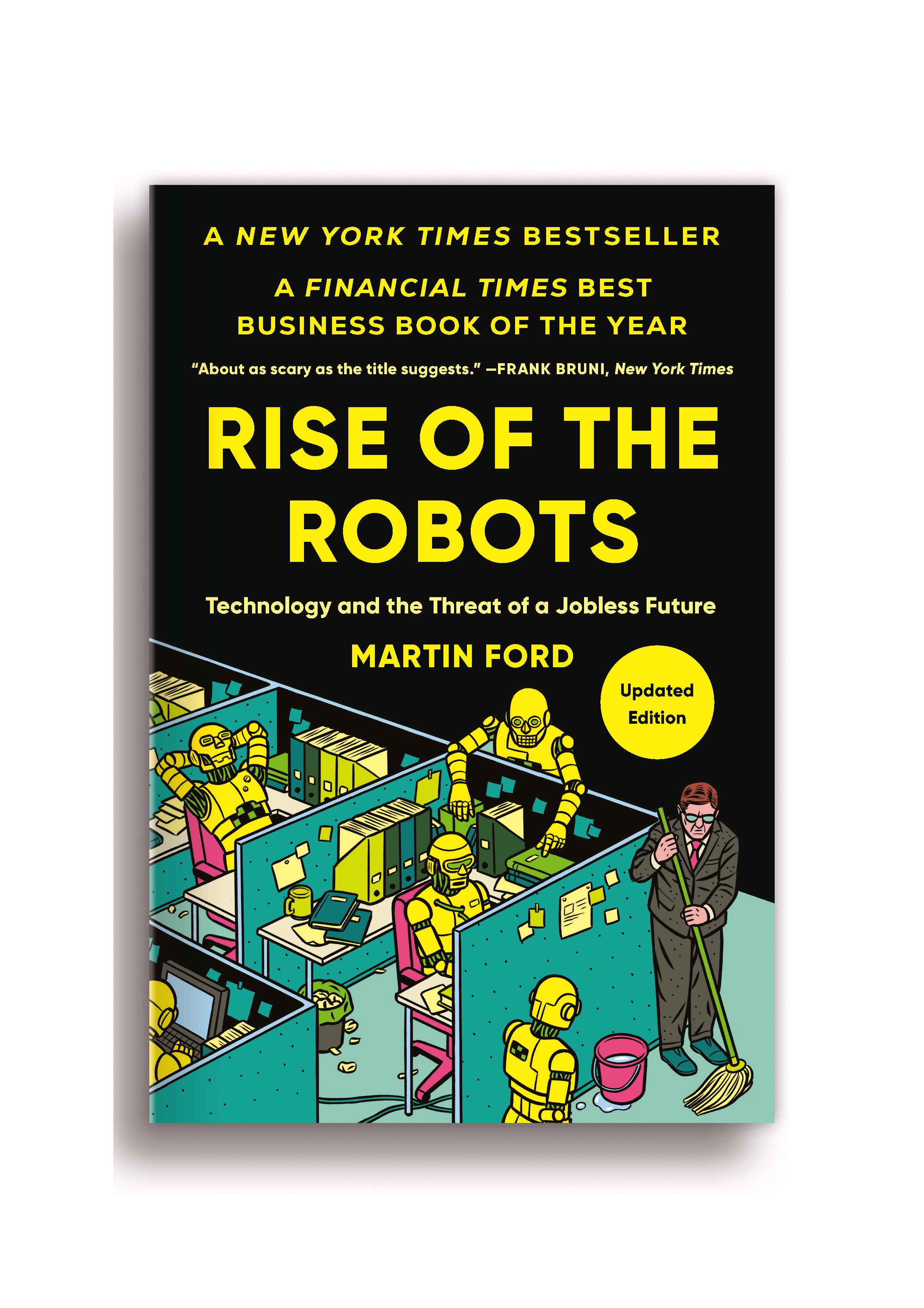
I’m pleased to announce that a new 2026 edition of my New York Times bestselling book, Rise of the Robots: Technology and the Threat of a Jobless Future will be published on June 2nd.
I have extensively updated the book to cover the latest advances in generative AI and robotics and to examine the future economic and job market implications of the unfolding AI disruption. The book focuses on what we can do as individuals, and as a society, to successfully navigate the looming transition into the age of AI.
My new book, Rule of the Robots: How Artificial Intelligence Will Transform Everything is now available in hardcover, ebook and audiobook versions. You can order here.
Advance Praise for Rule of the Robots
“Probably the most compelling single-volume book so far on AI’s advance and the opportunities and challenges associated with its multi-faceted impact on the world. Those in AI and those outside it will get a lot out of his clear-eyed and critical perspective. I highly recommend it.” ―James Manyika, Chairman and Director of the McKinsey Global Institute
“There is no technology more important today than AI. Martin Ford continues his tradition of clear insights and observations about this important topic in a well-researched page-turner. A delightful book!” ―Erik Brynjolfsson, Director of the Stanford Digital Economy Lab and co-author of The Second Machine Age
“The best up-to-date, go-to book on the social and economic implications of artificial intelligence.” ―Tyler Cowen, Professor of Economics at George Mason University
“An incisive, balanced, and well-informed discussion of where AI stands today, how it may evolve, and the risks it poses to human society.”―Stuart Russell, Professor of Computer Science at the University of California, Berkeley and co-author of Artificial Intelligence: A Modern Approach
“Writing about the future of robotics is a dangerous endeavor, since it illuminates every aspect of our lives with a startling, unchartered perspective. Ford navigates this challenge admirably, with an exceptional blend of depth, rigor and clarity.” ―Judea Pearl, winner of the A.M. Turing Award and co-author of The Book of Why
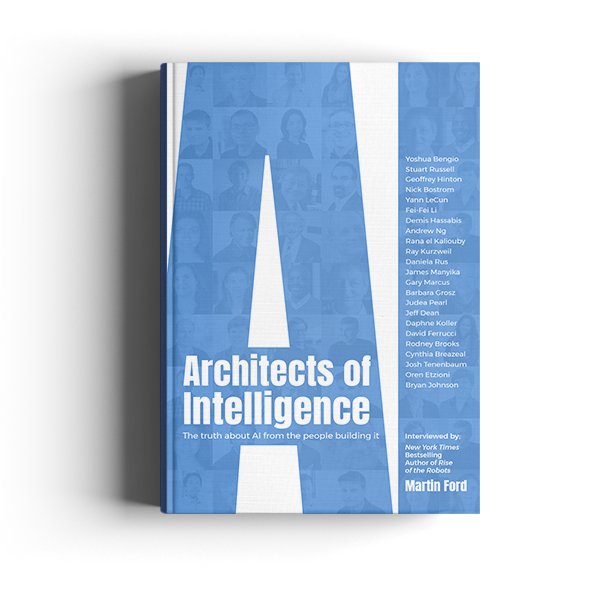
The book consists of deep, wide-ranging conversations about the future of AI—and the risks and opportunities that progress will bring—with 23 of the most prominent research scientists and entrepreneurs working in the field of artificial intelligence, including:
Demis Hassabis (DeepMind), Ray Kurzweil (Google), Geoffrey Hinton (Univ. of Toronto and Google), Rodney Brooks (Rethink Robotics), Yann LeCun (Facebook) , Fei-Fei Li (Stanford and Google), Yoshua Bengio (Univ. of Montreal), Andrew Ng (AI Fund), Daphne Koller (Stanford), Stuart Russell (UC Berkeley), Nick Bostrom (Univ. of Oxford), Barbara Grosz (Harvard), David Ferrucci (Elemental Cognition), James Manyika (McKinsey), Judea Pearl (UCLA), Josh Tenenbaum (MIT), Rana el Kaliouby (Affectiva), Daniela Rus (MIT), Jeff Dean (Google), Cynthia Breazeal (MIT), Oren Etzioni (Allen Institute for AI), Gary Marcus (NYU), and Bryan Johnson (Kernel).
#AI is creating opportunities and driving changes even AI experts can't fully predict. But if you want to know what today's AI experts are thinking – and what questions they're asking – @MFordFuture's new book, Architects of Intelligence, is a must-read! https://t.co/SgcLLesIB8
I’ve been working with the French bank Societe Generale and its ETF subsidiary, Lyxor, to create a stock market index and ETF focused on companies that will participate in the AI and robotics revolution. Our approach is unique in that it incorporates not just companies creating AI and robotics technology but also those best positioned to benefit from these advances. As a result our index/ETF provides much more diversification than competing approaches.
The ETF (ticker ROAI) started trading on September 18, 2018 on the London Stock Exchange in U.S. dollars and on Xetra and Borsa Italiana in euros.
On July 5, I’ll be participating in a conversation with White House Chief of Staff Denis McDonough and Zipcar co-founder Robin Chase about robots and automation and what they mean for the future. The event will be live-streamed from the White House starting at 1:15 EDT.
Update: A video of the session can be seen here. Topics included potential for AI/robots to create unemployment, basic income as a solution, and even the potential threat of superintelligent AI.
Google’s recent announcement that its DeepMind technology had defeated one of the world’s highest-ranked champions at the ancient game of Go is just one example of the many dramatic advances unfolding in the fields of artificial intelligence and robotics. Machines are rapidly taking on ever more challenging cognitive tasks, encroaching on the fundamental capability that sets humans apart as a species: our ability to make complex decisions, to solve problems — and, most importantly, to learn. DeepMind’s feat was especially remarkable not just because the technology ultimately prevailed, but because the system largely trained itself to do so.


 Martin Ford